- County
- Orange
- District type
- Urban core
- Signature park
- Lake Eola Park, 0.9-mile loop
- Arena
- Kia Center (Orlando Magic)
- Arts anchor
- Dr. Phillips Center for the Performing Arts
- Nightlife spine
- Orange Avenue, Church Street
- Housing character
- High-rise condos and apartments, townhomes
Where Downtown Orlando Sits
The Story of Downtown Orlando
Downtown Orlando is Central Florida's walkable urban core, the region's "City Beautiful" in the words the city has used for itself for decades. It grew up around the railroad depot and the lake that became Lake Eola Park, and over the past two decades it has been reshaped by big-ticket civic projects: the Kia Center arena, the Dr. Phillips Center for the Performing Arts, SunRail commuter rail, and a wave of high-rise residential towers.
The historic anchor of the district's nightlife is Church Street Station, which began as the Old Orlando Railroad Depot built in 1889 by the South Florida Railroad and opened in January 1890, serving as Orlando's main passenger depot until 1926. In the early 1970s an entrepreneur converted the depot and nearby buildings into a Dixieland-themed dining and entertainment complex that drew more than 1.7 million visitors in 1985, making it one of Florida's biggest tourist attractions at the time. The original entertainment complex closed in the early 2000s, but the 1889 depot building still stands at 4 Depot Place alongside a modern SunRail station, and the Church Street area around it remains the historical center of downtown's dining and nightlife.
Lake Eola and the Parks
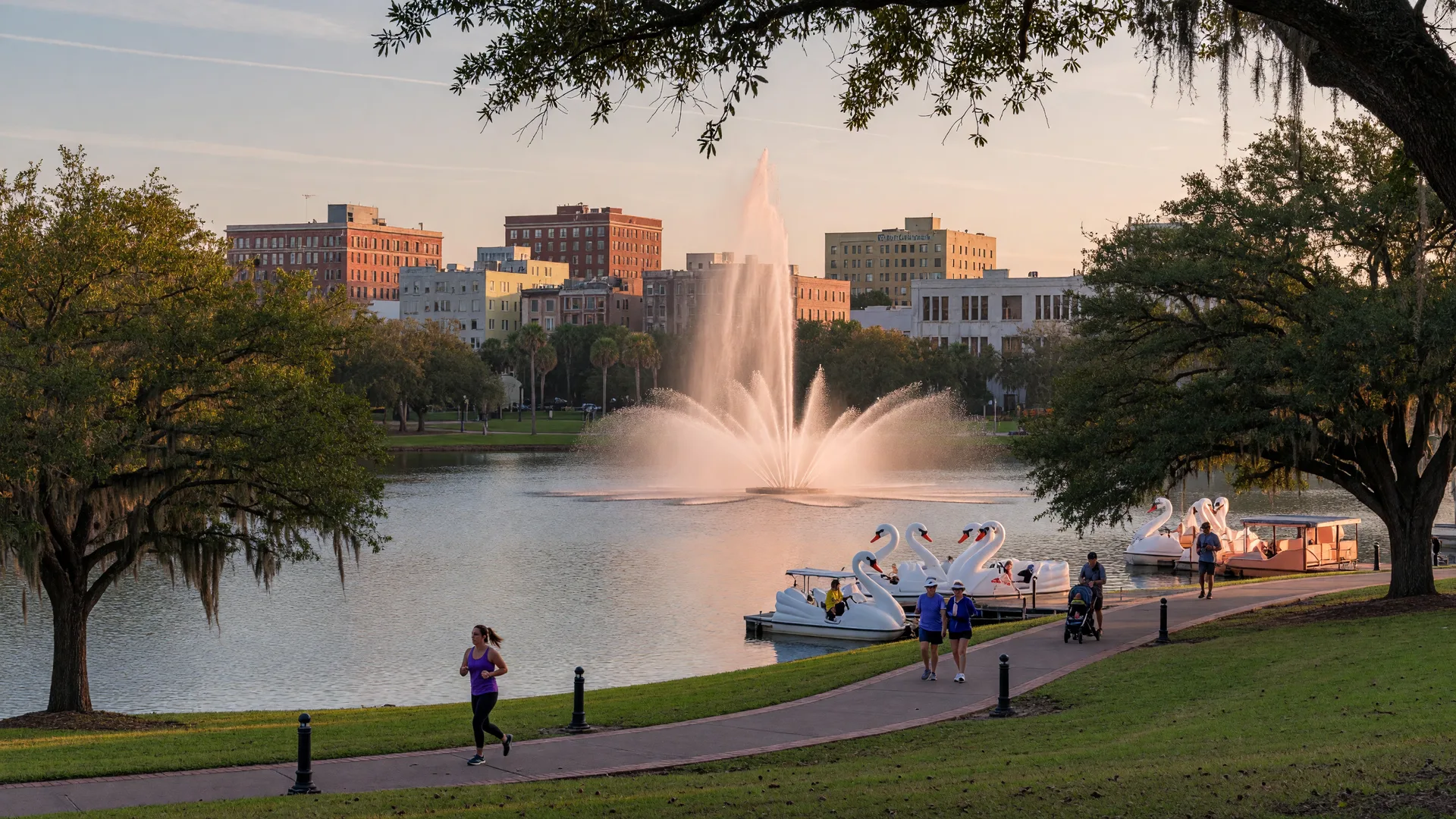
Lake Eola is a sinkhole lake fed by a natural aquifer about 200 feet below ground, and its park is downtown's signature public space, according to the City of Orlando and Downtown Orlando's published history. The land was donated by Jacob Summerlin, known as the Cattle King of Florida, and declared a public park in 1888, with the park officially recognized in 1892. The Linton E. Allen Memorial Fountain, often called the Centennial Fountain, now marks the center of the lake; the current fountain was installed in 1957 and renamed in 1966.
Lake Eola Park features a 0.9-mile walking loop around the lake, swan-shaped paddle boats, a Chinese pagoda, and the Walt Disney Amphitheater, and it has been named a top city park in the United States by USA Today's 10Best. A long-running farmers market operates at the park on Sundays; days, hours, and vendor lineups change, so confirm the current schedule with the city before planning around it. The park hosts festivals and community events through the year, including holiday celebrations that draw large crowds.
Dining and Entertainment Districts
Downtown's dining and nightlife is organized around a few walkable corridors. Orange Avenue is the district's spine, lined with bars, restaurants, and venues, and the Church Street District near the historic depot adds another cluster of restaurants and nightlife. Wall Street Plaza, tucked between Orange Avenue and Magnolia Avenue, is a long-running open-air complex of bars and restaurants that anchors the weekend scene.
Restaurants and bars verified as operating as of October 2026 include Kres Chophouse at 17 W. Church St., Ember at 42 W. Central Blvd., Elixir Kitchen and Bar at 9 W. Washington St., Wall Street Plaza at 25 Wall St., Warped Pour at 26 Wall St., and Fixtion Restaurant and Bar at 15 N. Orange Ave., among others. Menus, hours, and ownership change, so check each business directly.
Just beyond the core, the surrounding districts add depth to downtown living: the Thornton Park Local Life guide covers the Washington Street dining and shopping strip just east of the core, and the Ivanhoe Village guide covers the arts corridor north of downtown, including its breweries and Lake Ivanhoe.
The Kia Center
The Kia Center at 400 W. Church St. opened in 2010 as the Amway Center and was renamed in December 2023 under a naming-rights deal with Kia America, according to the arena's published information and news coverage. It is the home of the NBA's Orlando Magic and the ECHL's Orlando Solar Bears, seats about 18,800 for basketball with capacity for roughly 20,000 for concerts, and is topped by an LED-lit tower that makes it a visible landmark on the downtown skyline. The arena anchors the district's event calendar, hosting concerts and conventions in addition to sports. Event schedules and ticket information change constantly, so check the arena's site for current programming.
The Dr. Phillips Center
The Dr. Phillips Center for the Performing Arts at 445 S. Magnolia Ave. is the performing arts anchor of the district, owned by the City of Orlando. Its venues include the roughly 2,700-seat Walt Disney Theater for Broadway tours and major concerts, the 1,700-seat Steinmetz Hall for acoustic performances including the Orlando Philharmonic, plus the Alexis & Jim Pugh Theater and Judson's Live for smaller shows and cabaret-style performances, according to the center's published venue information. Production schedules, ticket prices, and hours change constantly, so check the center directly before planning around a specific show.
The Walkable Character
By Orlando standards, downtown is the region's most walkable district. The Lake Eola loop, the close cluster of the Kia Center, Dr. Phillips Center, and Inter&Co Stadium (home of Orlando City SC, MLS soccer) along Church Street, plus SunRail and LYNX transit access, make the core one of the few places in Central Florida where a car-free or one-car household is realistic. The neighborhoods around the lake, including South Eola and Thornton Park, extend the walkable footprint beyond the immediate business district.
Transit is practical for some residents: SunRail's Church Street station provides weekday commuter rail service north to Winter Park, Maitland, Longwood, Lake Mary, and Sanford, and Lynx bus service connects the core to the wider region. Parking downtown is structured and paid, which is one reason walking and transit matter for daily life.
Housing Context
Downtown Orlando's housing is dominated by high-rise condominiums and apartments, with a growing number of mid-rise rentals, and a smaller stock of townhomes in the adjacent in-town neighborhoods. Price points vary widely by building, view, and age, and many downtown-dwellers rent rather than buy because the high-rise inventory skews toward apartments. Buyers who want more space or a yard typically look to the surrounding neighborhoods rather than the immediate core.
The Neighborhood Shortlist Workbook is a practical tool for comparing downtown living against in-town districts like Thornton Park, South Eola, and College Park before touring, and the Moving Checklist covers the practical steps of the move itself.
Things to Consider Before Moving Downtown
Condos, HOAs, and rentals
Most downtown housing is in condo and apartment towers with association fees or rent. Review HOA budgets, assessments, and building reserves before buying a condo.
Parking and traffic
Parking is mostly structured and paid, and event nights at the arena and arts center bring heavy traffic. Factor the cost of parking or a garage space into your budget.
Nightlife noise
Units close to Orange Avenue, Church Street, and Wall Street Plaza can be noisy on weekend nights and event evenings. Visit a candidate building on a Friday night before committing.
Space and storage
High-rise units are compact and storage in older towers can be limited. Compare square footage, balconies, and storage carefully against your household's needs.
Nearby Communities and Related Guides
Frequently Asked Questions About Downtown Orlando
How big is the Lake Eola walking loop?
Lake Eola Park features a 0.9-mile paved walking loop around the lake, with swan-shaped paddle boats, a Chinese pagoda, the Walt Disney Amphitheater, and the Linton E. Allen Memorial Fountain at the lake's center.
What are the main dining and nightlife areas?
Orange Avenue is downtown's main corridor, the Church Street District anchors the historic nightlife near the old depot, and Wall Street Plaza is a long-running open-air complex of bars and restaurants. Thornton Park and Ivanhoe Village add options just outside the core.
Where do the Orlando Magic play?
The Orlando Magic play at the Kia Center at 400 W. Church St., which opened in 2010 and was renamed in December 2023 under a naming-rights deal with Kia America.
Is downtown Orlando walkable?
Yes, by Orlando standards. The Lake Eola loop, the cluster of venues along Church Street, and SunRail and Lynx transit access make the core one of the most walkable and transit-connected districts in Central Florida.
What transit serves downtown Orlando?
SunRail's Church Street station provides weekday commuter rail service north to Winter Park, Maitland, Longwood, Lake Mary, and Sanford, and Lynx bus service connects the core to the wider region.
Sources and Reporting
Facts on this page were checked against public sources in October 2026: Downtown Orlando's published history and Lake Eola pages; the City of Orlando's Lake Eola Park and history pages; the Kia Center's published venue information and naming-rights coverage; the Dr. Phillips Center's published venue information; the Church Street Station history published by the City District and the History Center; and current local business listings for Orange Avenue, Church Street, and Wall Street. Event schedules, menus, ticket prices, and business hours change, so verify with the official source before planning around them.
Last updated: October 13, 2026 at 20:56 UTC. Published by Moving to Orlando Guide with Tyler Gibson.