Moving to Orlando Guide · November 2, 2026
Flood Insurance in Orlando: Zones, Costs, and What to Check
Do you need flood insurance to buy a home in Greater Orlando? It depends on the property, not on the region. Flood insurance is federally required when a home sits in a FEMA Special Flood Hazard Area and carries a federally backed mortgage, and Florida is phasing in a flood coverage requirement for most Citizens Property Insurance wind policies by January 1, 2027. Even outside mapped high-risk zones, flooding happens: FEMA and FloodSmart data show about one in three flood claims comes from properties in low-to-moderate risk areas. This guide explains how zones work, where flood risk concentrates in the five-county region, what coverage costs, and what to verify before you make an offer.
The "100-year floodplain" is not what it sounds like
FEMA divides the country into flood zones, and the most common shorthand people hear is "100-year floodplain." That label is misleading. A FEMA Special Flood Hazard Area, often called the 1-percent-annual-chance floodplain, has a 1 percent chance of flooding in any given year. Over the life of a 30-year mortgage, FEMA's glossary puts the odds at about a 26 percent chance that the property floods at least once. The "100-year" name refers to probability per year, not a once-a-century event, and the region has seen back-to-back storms flood the same river systems in the last few years.
For a moving family, the practical version of this is simple: flood risk in Central Florida is property-level, not regional. One parcel can sit on a bluff above a lake while the lot two streets away is in a mapped flood zone, and flood-risk maps are revised over time. The steps below walk through how to check the zone for a specific address, what the zone tells you, and what insurance and Florida law add on top.
How FEMA flood zones work
FEMA's Flood Insurance Rate Maps (FIRMs) assign every mapped property a zone letter. The high-risk designations are the Special Flood Hazard Areas, or SFHAs, which begin with A or V and carry at least a 1 percent annual chance of flooding. That zone letter is the single most important thing to check on a property you are considering.
| Zone | Risk level | What it means |
|---|---|---|
| A | High | Special Flood Hazard Area where no detailed study has been done, so no Base Flood Elevation is shown. |
| AE | High | Special Flood Hazard Area with a Base Flood Elevation set by a detailed analysis. The most common high-risk designation in inland Central Florida. |
| VE | High | Coastal high-hazard area with wave action and a Base Flood Elevation. This zone is on the coasts, not in the Orlando region. |
| Shaded X | Moderate | Within the 0.2 percent annual chance (500-year) floodplain. Insurance is not federally required here, but flooding is still possible. |
| Unshaded X | Minimal mapped risk | Outside mapped floodplains. Insurance is not federally required, yet local, stormwater, and flash flooding can still occur. |
Source: the FEMA flood zones glossary, current as of late 2026. One clarification worth making: being outside the SFHA does not mean flooding is impossible. FEMA and FloodSmart report that about one in three flood insurance claims comes from properties in low-to-moderate risk zones, using NFIP claims data covering 2014 to 2024. The moderate and minimal categories simply mean the mapped likelihood is lower, not zero.
How to check a property's flood zone
You do not need anyone's permission to look this up. The official public source is the FEMA Flood Map Service Center, where a property address search returns the FIRM panel and the zone letters for that location. FEMA's National Flood Hazard Layer viewer shows the same information on a color-coded map. The local governments add their own layer on top:
- Orange County publishes floodplain information through its online InfoMap service and the property appraiser's site, so you can see a parcel against the mapped floodplain.
- Seminole County uses the FIRMs as its baseline but maintains its own additional flood studies, and its building division can provide a flood zone determination for a property.
- Osceola County offers free verbal flood zone determinations through its Flood Map Services program, with written determinations available on request for unincorporated areas.
- Lake and Polk counties both follow the effective FIRMs; their building and floodplain departments are the places to confirm a zone before you rely on it for a purchase.
Maps change as FEMA studies are revised, so check the effective panel date and ask your lender what panel it uses for the flood determination. The relocation glossary defines the insurance and flood terms you will see on these pages.
Where flood risk concentrates in Greater Orlando
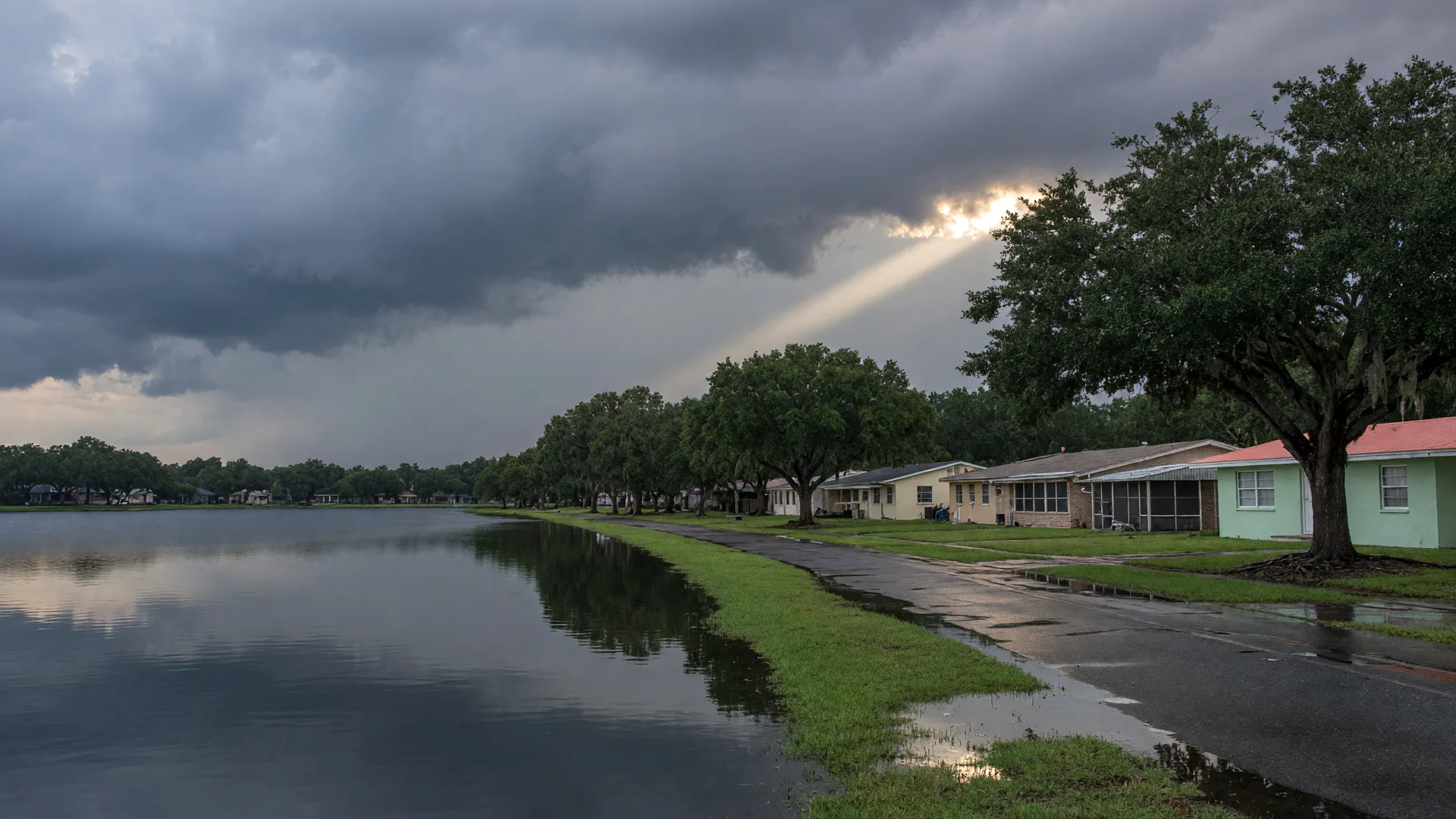
Central Florida sits on relatively high ground compared with the state's coasts, but it is laced with lakes, rivers, and wetlands, and the mapped flood zones follow the water. The main corridors where flooding concentrates, based on National Weather Service and news reporting after recent storms, are the slow, flat river systems more than any single city:
- The St. Johns River system. The St. Johns runs north through the region and is famously flat, so floodwaters recede slowly, sometimes over weeks. The corridor from Geneva and Lake Harney through Lake Jesup and Lake Monroe at Sanford to Astor in Lake County is the region's best-known flood-prone stretch. After Hurricane Milton in October 2024, the St. Johns at Christmas crested at 9.43 feet and areas along Lake Harney reached major flood stage, with structures in Seminole County left inaccessible for days, per the Orlando Sentinel and ClickOrlando.
- The Econlockhatchee and Little Econlockhatchee rivers in east Orange and Seminole counties, which drain into the middle St. Johns and have wide, low floodplains.
- The Wekiva and Little Wekiva rivers in southwest Seminole County. The Little Wekiva saw record crests near Altamonte Springs during Hurricane Ian in September 2022 and flooded again near Spring Oaks after Milton in 2024.
- The Kissimmee Chain of Lakes, including Lake Tohopekaliga and East Lake Tohopekaliga around Kissimmee and St. Cloud. During Ian, the Kissimmee area saw near-catastrophic flooding after more than a foot of rain, with dozens of rescues reported by FOX Weather and WLRN.
- The Peace River and Green Swamp system in Polk County. Lakeland saw what local officials called historic, roughly 1-in-1,000-year flooding during Milton in October 2024, and the Peace River near Bartow reached moderate flood stage, per The Ledger and Polk County.
- The Withlacoochee and Ocklawaha rivers in Lake County, which flooded to major stages after Milton, with the St. Johns crossing through Astor at the county's northeast edge.
The point of listing these corridors is not to suggest that any whole community is off-limits. It is the opposite: flooding follows specific geography, and the difference between one subdivision and the next can be a matter of feet of elevation. Check the parcel, check the zone, and check how the water drains around the property. For buyers drawn to the water, the lake living guide covers what waterfront ownership involves, and the hurricane preparedness guide explains how the region's storm seasons work.
Is flood insurance required in Florida?
Florida state law does not require every homeowner to carry flood insurance. In practice, three separate rules create most of the requirement:
- Lenders require it in high-risk zones. When a home is in a FEMA Special Flood Hazard Area and is financed with a federally backed or regulated mortgage, federal rules require flood insurance for the life of the loan. If the buyer does not purchase it, the lender purchases it and passes the cost along, which is known as force-placing.
- Citizens is phasing it in. Florida's insurer of last resort, Citizens Property Insurance Corporation, must have flood coverage on most of its personal residential wind policies under Senate Bill 2-A of 2022 and Florida Statute 627.715. The schedule, as published by Citizens, is shown below.
- The seller must tell you about flooding. A separate 2024 Florida law, covered in the disclosure section below, puts flood history questions in writing at the contract stage.
| Citizens policy type | Flood coverage required from |
|---|---|
| Homes in a FEMA Special Flood Hazard Area | New policies on or after April 1, 2023; renewals on or after July 1, 2023 |
| Dwelling replacement cost $600,000 and up | January 1, 2024 |
| Dwelling replacement cost $500,000 and up | January 1, 2025 |
| Dwelling replacement cost $400,000 and up | January 1, 2026 |
| All remaining personal residential wind policies | January 1, 2027 |
Source: Citizens Property Insurance Corporation's published flood requirements, current as of November 2026. The flood coverage can come from the NFIP or an approved private insurer, and it must be kept in force as a condition of the Citizens wind policy. In practice, that means almost any new home insured through Citizens will carry a separate flood policy by 2027. The Florida homeowners insurance guide explains how Citizens fits into the broader wind and property insurance picture.
What the 2024 flood disclosure law requires
Since October 1, 2024, Florida's House Bill 1049, codified as Section 689.302 of the Florida Statutes, requires the seller of residential real property to provide a written flood disclosure form to the buyer at or before the time the sales contract is executed. The form tells the buyer that homeowners insurance does not cover flood damage, asks whether the seller has filed a water-damage insurance claim on the property within the prior five years, asks whether the seller has received federal flood assistance such as FEMA funds, and defines flooding for the purpose of the form. The Florida Realtors association publishes the official form. Ask your agent for it before you sign, not after; it is one of the few places where previous water damage at a specific address is required to be answered in writing.
What flood insurance covers, and what it does not
Flooding is a specific legal category, and the split between "flood" and "water damage" surprises most new residents. Under the National Flood Insurance Program, a flood is a general and temporary condition of partial or complete inundation of two or more acres of normally dry land, or of two or more properties, from overflowing inland or tidal waters, unusual or rapid runoff, mudflow, or storm surge. Water from outside the home, whether from a swollen lake, a flash-flooded street, or rain that saturates the ground and seeps in, is flood.
A standard Florida homeowners policy excludes flood. The Florida Office of Insurance Regulation states plainly that most homeowners policies do not cover flooding, and that flood coverage must be purchased separately through the NFIP or a private flood insurer. What a standard policy does cover is sudden and accidental water from an internal source: a burst pipe, a ruptured water heater, a flooding washing machine, or a failed air-conditioning condensate line. Two common gaps: gradual leaks are usually treated as maintenance and excluded, and sewer or drain backup requires a separate endorsement on most policies. The 2026 Florida insurance guide goes through these distinctions in more detail.
If you do buy flood coverage, the NFIP Dwelling Form covers up to $250,000 for the building and $100,000 for contents for a single-family home, per the program's coverage tables published by FEMA in late 2025. Buyers with homes valued above those levels, which is common in parts of Greater Orlando, typically layer private flood coverage on top of an NFIP policy or use private flood insurance alone.
What flood insurance costs in 2026
Flood insurance prices in Florida are a subject of their own, and the honest answer is that they vary widely by property. The two structural facts to know:
Risk Rating 2.0 changed how premiums are set. FEMA's Risk Rating 2.0, which the Congressional Research Service describes as the biggest change to NFIP pricing since the program began in 1968, prices each property on its own risk instead of just its zone letter. New policies moved to the new method on October 1, 2021, renewals followed on April 1, 2022, and the system was fully implemented on April 1, 2023, per FEMA. Premiums now factor in distance to water, flood frequency and type, the foundation type, the height of the lowest floor relative to the Base Flood Elevation, prior claims, and replacement cost. Statutory caps limit annual increases to 18 percent for most primary residences and 25 percent for non-primary or non-residential properties until full-risk rates are reached, and FEMA estimates that 96 percent of policyholders see either an immediate decrease or an increase of $20 per month or less.
What it costs in Florida. Florida is the NFIP's largest market by far. FEMA's April 2025 Florida state profile reports about 1.7 million NFIP policies in force in the state, roughly 1,727,900. Market analyses of FEMA policy data (FludZone) and comparisons from NerdWallet in 2026 put the average Florida NFIP premium in the range of about $912 to $938 per year. The same FEMA profile shows how the new pricing landed: about 20 percent of Florida policies saw immediate premium decreases, 68 percent saw increases of $0 to $10 per month, 8 percent saw $10 to $20 per month, and 4 percent saw more than $20 per month. A waterfront lot in an AE zone will generally price well above the state average, and a mid-county home on high ground will typically price well below it, which is why a quote for the specific address is the only number that matters.
Private flood insurers compete with the NFIP in Florida, and a policy from an approved private carrier can satisfy a lender and the Citizens requirement if it meets the statutory standards. It is worth comparing an NFIP quote with at least one private quote for the same property, because the two can differ substantially by location and house type. The cost of living hub includes insurance figures for budgeting a Central Florida move.
The 30-day waiting period
Here is the timing trap that catches buyers: a new NFIP policy does not start the day you buy it. Per FloodSmart, FEMA's consumer site, a new flood policy generally takes effect 30 days after you apply and pay, at 12:01 a.m. local time on the 30th calendar day. There are exceptions, and the important one for home buyers is that there is no waiting period when the policy is purchased in connection with making, increasing, extending, or renewing a mortgage loan; it can be effective at closing. There is also no waiting period when a policy is bought within 13 months of a FIRM revision that newly places the property in a high-risk zone, and a one-day rule applies in a few other cases.
The practical takeaway: if the property is in an SFHA, have the flood binder in hand at closing, handled as part of the loan transaction, rather than shopping for coverage after you have the keys. A 30-day gap between closing and coverage is exactly the window when a slow-moving lake or river flood arrives.
Elevation certificates, freeboard, and the 50 percent rule
Three tools come up constantly in flood-zone real estate, and buyers should understand them before making an offer on a lake or river property.
The Elevation Certificate. This is the FEMA form a licensed surveyor fills out that records the property's flood zone, the elevation of the lowest floor, and the adjacent grade. Insurers use it to rate premiums, and it is effectively required for properly pricing a post-FIRM building in an AE zone. Buyers should ask whether the seller has one on file; hiring a surveyor for a new certificate typically runs on the order of $400 to $700 in Florida, per floodplain guidance from Florida counties. If a home is elevated above the Base Flood Elevation, the certificate proves it.
Freeboard and elevation. The gap between the lowest floor and the Base Flood Elevation is called freeboard, and under Risk Rating 2.0 premium rates fall continuously as that gap grows. FEMA's flood-insurance materials describe elevating the home as the fastest way to reduce flood insurance costs, citing savings on the order of 25 to 41 percent or more with just one to two feet of freeboard. New construction in much of the region is built with freeboard by design; a resale home may or may not have it, and checking the elevation certificate reveals the answer.
The Letter of Map Amendment (LOMA). When a specific lot sits on naturally high ground that reaches the Base Flood Elevation, the owner can ask FEMA for a LOMA, an official letter removing that property from the SFHA on the effective map. That removes the federal requirement to buy flood insurance for a federally backed loan, though a lender may still require it at its discretion. A LOMA is property-specific and does not change the map for the neighborhood.
The 50 percent rule. This is the one that affects renovations. Under NFIP rules in 44 CFR 59.1, a home in a Special Flood Hazard Area must be brought up to current floodplain construction standards if repairs, remodeling, or additions cost 50 percent or more of the structure's market value, with land value excluded. That usually means elevating the lowest floor to the Base Flood Elevation plus freeboard, which is expensive and sometimes uneconomical on an older home. Orange County's floodplain rules, for example, require a finished floor one foot above the Base Flood Elevation when the threshold is crossed, and some communities count improvement costs cumulatively over several years. Before planning a renovation of a flood-zone home, call the county floodplain or building department with the parcel information and get the answer in writing.
What to check before you buy
1. Pull the map yourself
Search the address on the FEMA Flood Map Service Center and note the zone letters and the effective panel date. Then confirm with the county floodplain department, because local studies can refine the federal map.
2. Read the seller's flood disclosure
Under the 2024 Florida law, the seller must provide the written flood disclosure form before contract execution. It asks about water-damage claims in the prior five years and any federal flood assistance. Ask for it and read it with your agent.
3. Get a real quote for the address
Ask the seller for the current flood policy and premium if there is one, then get your own NFIP and private-market quotes. Budget flood, wind, and homeowners premiums together, because the total is what you will pay every year.
4. Ask about the Elevation Certificate
If the seller has one, review it with your insurance agent before offering. In a high-risk zone, an elevated home can price dramatically differently from a slab home, and the certificate is the document that proves which one you are buying.
5. Plan the closing timeline
If the property is in an SFHA, your lender will require flood coverage at closing, and the NFIP's 30-day waiting period is waived for a policy bought as part of the mortgage transaction. Have the binder in hand before the closing date.
6. Think about renovations before you buy
A flood-zone home priced for a remodel can be a great value, but the 50 percent rule can force an expensive elevation. Check with the county floodplain office about the improvement threshold before you budget for upgrades.
The moving checklist and the first-time homebuyer guide both place insurance due diligence inside the broader purchase timeline, and the free Sight-Unseen Remote Buyer's Protection Toolkit includes flood checks among its inspection points for buyers searching from out of state.
Frequently asked questions
Is flood insurance required to buy a home in Greater Orlando?
Only in specific situations. Federal rules require it when the home is in a FEMA Special Flood Hazard Area and financed with a federally backed or regulated mortgage, and Florida's Citizens Property Insurance Corporation requires flood coverage on most of its personal residential wind policies, with the final phase taking effect January 1, 2027. For a cash purchase outside a high-risk zone, flood insurance is optional under the law, though it is still worth weighing given that about one in three flood claims comes from low-to-moderate risk zones.
What flood zone is my property in, and how do I check?
Search the address on the FEMA Flood Map Service Center (msc.fema.gov) to see the Flood Insurance Rate Map panel and the zone letters. The high-risk SFHA designations begin with A or V; shaded X is moderate risk; unshaded X is minimal mapped risk. Local governments in the region can confirm: Orange County through its InfoMap service, Seminole County through its building division flood determination, and Osceola County through its Flood Map Services program.
Does homeowners insurance cover flooding?
No. The Florida Office of Insurance Regulation states that most homeowners policies do not cover flood damage, and flood coverage must be bought separately through the NFIP or a private flood insurer. A standard policy covers sudden internal water events such as a burst pipe, while rising outside water, storm surge, and rain-driven inundation are flood and are excluded. Sewer backups typically need a separate endorsement.
How much does flood insurance cost in Florida?
Policy analyses of FEMA data place the average Florida NFIP premium at roughly $912 to $938 per year as of 2026, but the average hides a wide range. Risk Rating 2.0 prices each property on its own risk, so a waterfront home in an AE zone will usually cost more and a high-ground lot in X below it. The only useful number is a quote for the specific address, compared between NFIP and at least one private insurer.
Is a home outside a high-risk flood zone safe from flooding?
No property can be called flood-safe. FEMA and FloodSmart report that about one in three flood insurance claims comes from properties in low-to-moderate risk zones (2014 to 2024 claims data), and flash flooding after heavy rain can occur on streets in unshaded X areas. The zone tells you the mapped likelihood and whether insurance is federally required; it does not guarantee dry ground.
When does flood insurance coverage start?
A new NFIP policy generally takes effect 30 days after purchase. The main exception for buyers is that a policy bought in connection with making, increasing, extending, or renewing a mortgage can be effective at closing, which is why the flood binder should be part of the loan process for a high-risk property rather than arranged after closing.
What does the Florida flood disclosure form ask the seller?
Since October 1, 2024, Florida Statute 689.302 requires the seller of residential property to provide a written flood disclosure at or before contract execution. It states that homeowners insurance does not cover flood damage, asks whether the seller has filed a water-damage insurance claim on the property within the prior five years, asks whether the seller has received federal flood assistance such as FEMA funds, and defines flooding for the form.
What is the 50 percent rule for flood-zone homes?
Under NFIP rules, a home in a Special Flood Hazard Area must be brought up to current floodplain standards when repairs, remodeling, or additions cost 50 percent or more of the structure's value, excluding land. That normally means elevating the lowest floor above the Base Flood Elevation, which is expensive. County floodplain departments, including Orange and Seminole, enforce these thresholds, so call them before renovating a flood-zone property.
Does the Citizens flood requirement affect me if I insure through another company?
Not directly. The Citizens requirement applies to Citizens personal residential policies that include wind coverage, phased in by policy value and fully in force by January 1, 2027. If you insure with a private carrier, your lender's rules still control whether flood coverage is required, based on the property's flood zone and your loan type.

Written by Tyler Gibson, Realtor, Investor, Team Leader, GPG | LPT Realty, FL License #3454664. Moved to Orlando in 2012. Se habla espanol.
Shopping for a home and sorting out flood zones?
Start with the free Sight-Unseen Remote Buyer's Protection Toolkit, which includes flood and insurance checks alongside the rest of the due diligence, then book a relocation consultation to work through the specifics of any property on your shortlist.
Related resources
- Florida homeowners insurance guide: wind coverage, Citizens, and how flood insurance fits alongside it.
- 2026 Florida insurance guide: four-point inspections, wind mitigation, and the cost of owning a home in Florida.
- Lake living in Central Florida: what waterfront ownership involves, from boating rules to insurance.
- Hurricane preparedness guide: what to do before, during, and after a storm in Greater Orlando.
- Homeowner's guide: insurance, HOA, CDD, and property tax for new Central Florida owners.
- Sight-Unseen Remote Buyer's Protection Toolkit: a 27-point checklist that includes insurance and flood checks for out-of-state buyers.
- The Moving to Orlando Blog: more researched articles for new residents.
Last updated: November 2, 2026, 12:54 UTC. Published by Moving to Orlando Guide with Tyler Gibson. This article is informational and is not insurance, legal, engineering, or tax advice; verify current rates, rules, and map panels with FEMA, your county floodplain office, your insurer, and your lender.
Questions about flood zones and insurance in Central Florida?
Call or text Tyler at (407) 934-0320
Email: tyler@gpghome.com